STRUCTURAL CORRECTION CHIROPRACTIC IN TORONTO
Pain is often what brings someone to a chiropractor. But pain does not always tell the whole story.
At Source Chiropractic, I use the term structural correction to mean something specific: pursuing measurable improvement in spinal alignment or curvature when I find a structural issue that I believe is relevant to the person’s health, function, or goals.
That is different from simply asking whether someone feels better after treatment.
Symptoms matter. So do posture, movement, function, and quality of life. But when I find a measurable structural problem, I may also ask whether the alignment itself can reasonably be improved.
That means looking at questions such as:
Is there a measurable change in spinal curvature or alignment?
Does that finding appear meaningful for this person?
Can it reasonably be changed?
And if we pursue correction, can we measure the change rather than assume it happened?
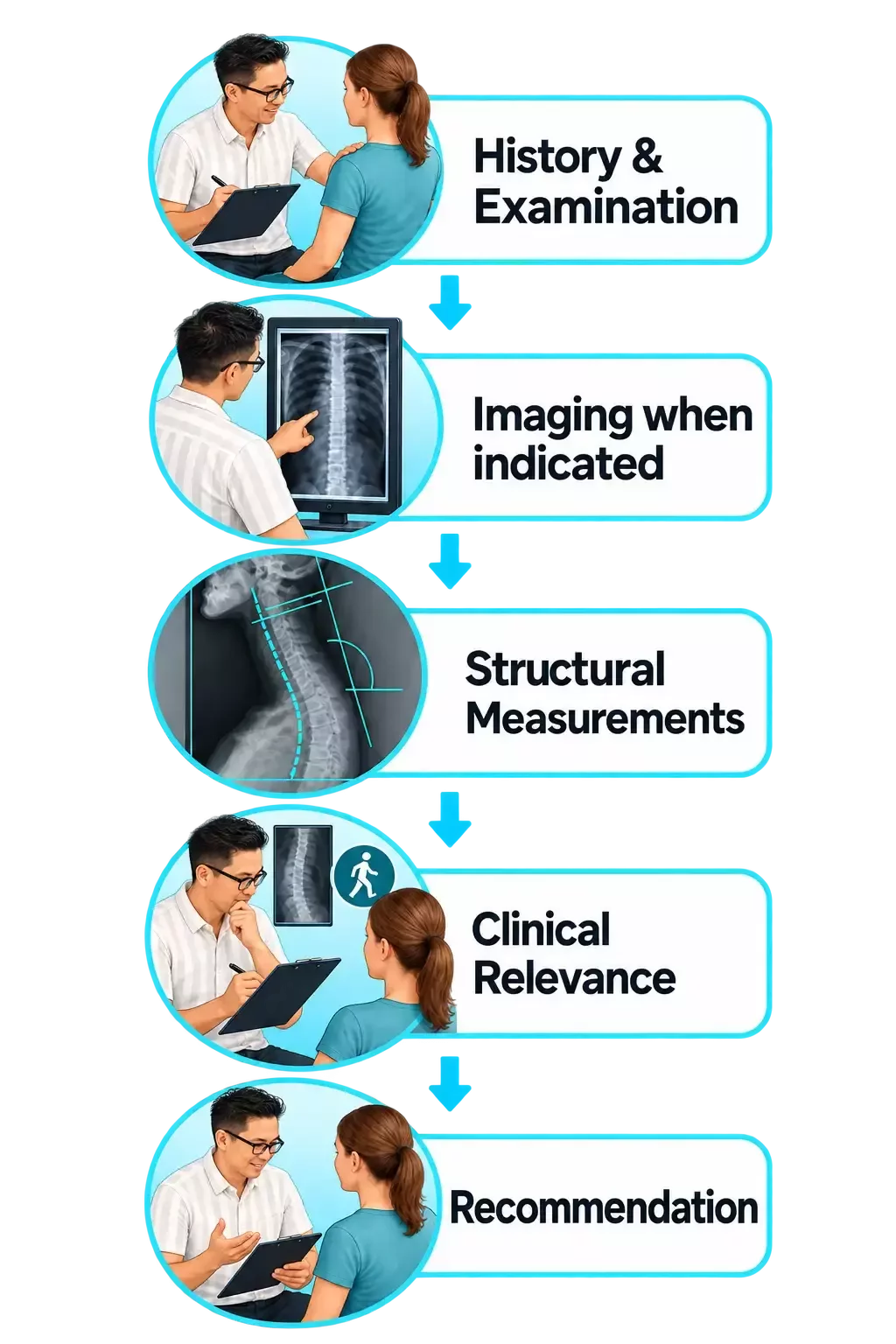
I do not recommend structural correction to every patient. I base that decision on the person’s history, examination findings, imaging when indicated, function, symptoms, goals, and the nature of the structural findings themselves.
Clinical review by Dr. Leo Quan, DC
Last updated: October 2026
WHAT IS STRUCTURAL CORRECTION?
At Source Chiropractic, structural correction means pursuing measurable improvement in spinal alignment or curvature when a meaningful structural finding is present.
The word structural matters.
It does not simply mean:
- reducing pain
- loosening tight muscles
- improving how someone feels after treatment
- standing a little straighter
- temporarily increasing range of motion
Those things may all be useful outcomes, but they are not the same as changing spinal structure.
Structural correction asks a more specific question:
Can a measurable spinal alignment or curvature finding improve over time?
That may include findings such as an altered spinal curve, segmental displacement, scoliosis, or another measurable alignment relationship.
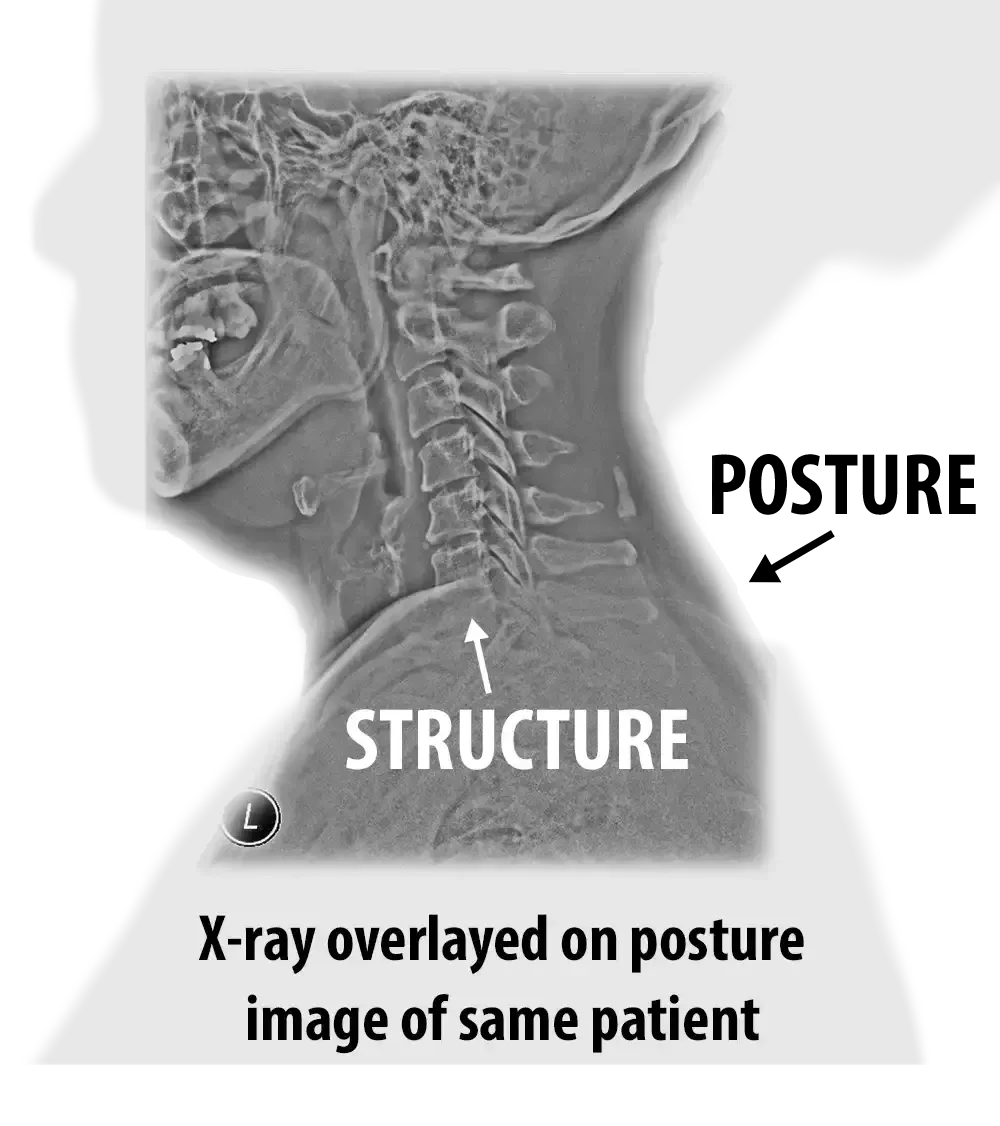
This is also where I separate structural correction from posture correction.
Posture describes how your body organizes itself externally when you stand, sit, and move.
Spinal structure refers to the position and curvature of the vertebrae relative to one another.
They are related, but they are not the same thing.
Someone can show a visible postural difference without having a matching structural spinal change. The opposite can also happen – a measurable spinal alignment finding may exist even when it is not obvious from external posture alone.
That is why I do not use posture photography as a substitute for spinal imaging, and I do not interpret X-rays without considering how the person stands, moves, functions, and feels.
When structural correction makes sense, the primary structural goal is straightforward:
to produce measurable improvement in a spinal alignment or curvature finding that matters for that individual.
Other changes may come with that.
Improving spinal alignment may reduce unnecessary mechanical demand. Posture may change. Movement may become easier. Capacity may improve. Symptoms may improve.
But I treat those as related outcomes rather than the definition of structural correction itself.
STRUCTURAL CORRECTION vs. SYMPTOM-RELIEF CHIROPRACTIC
Symptom relief is important.
If someone comes in with neck pain, back pain, stiffness, headaches, or another musculoskeletal complaint, reducing discomfort and improving function may be a very reasonable first goal.
But feeling better and changing spinal structure are not the same thing.
A patient can feel much better without a measurable spinal alignment finding changing.
And a structural finding can still be present even when symptoms are mild or absent.
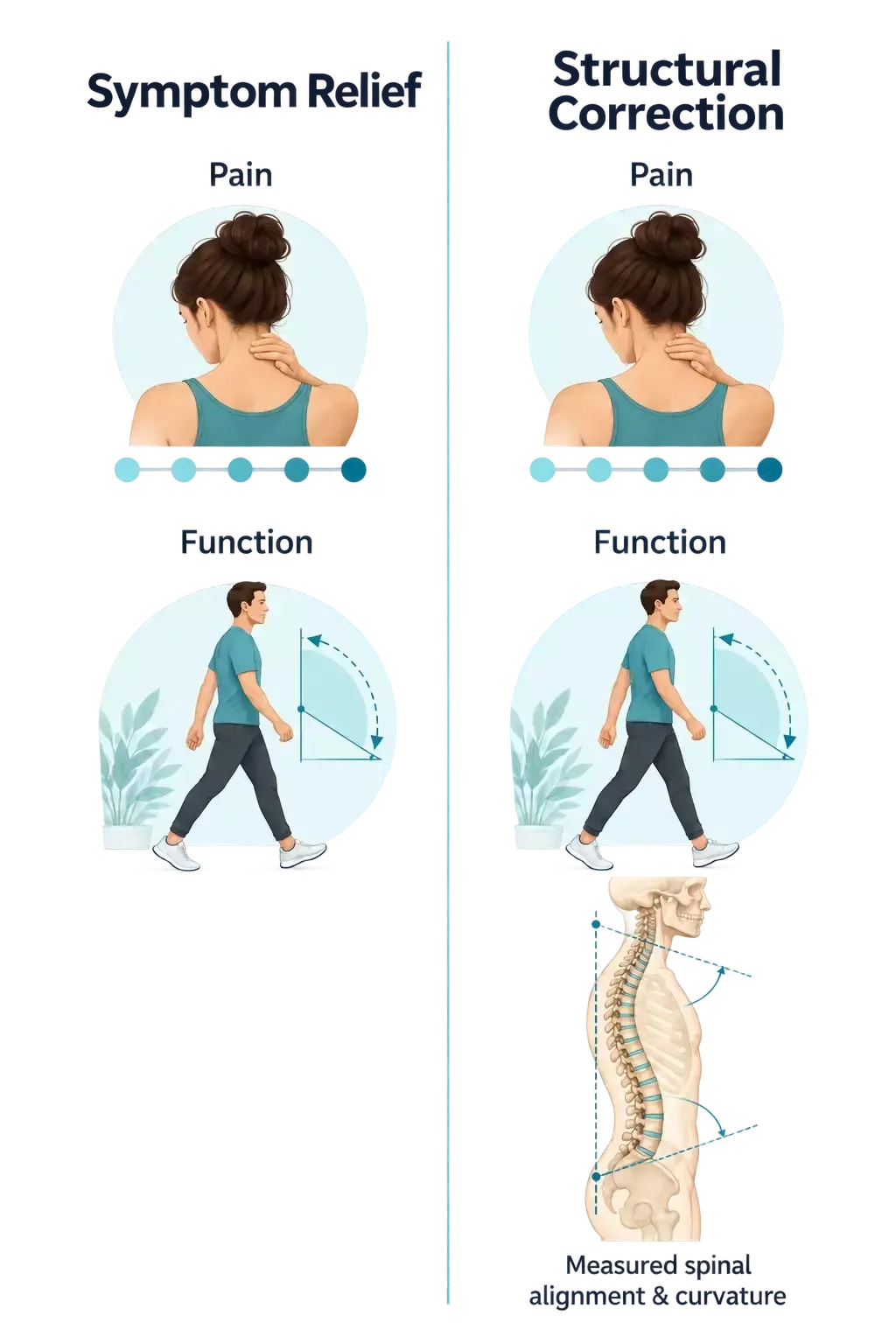
That is the main difference between symptom-relief chiropractic and structural correction.
Symptom-relief care asks:
“Are you feeling and functioning better?”
The focus may be on pain, stiffness, movement, or helping someone get back to normal activity.
Structural correction adds another question:
“Has the measurable spinal structure changed?”
To answer that, I need an objective baseline and a way to compare the same finding over time.
I do not see these approaches as opposites.
A patient receiving structural corrective care may also want:
- less pain
- easier movement
- better tolerance for work or activity
- improved function
- better posture
- fewer recurring episodes
Those goals still matter.
But when I find a structural issue that I believe is important, I may recommend going beyond symptom relief and making measurable improvement in the alignment itself part of the goal.
That also means I do not assume that feeling better proves structural correction has taken place.
If structural change is one of the goals of care, I want to measure it against the original finding.
HOW WE DETERMINE WHETHER STRUCTURAL CORRECTION IS RELEVANT
I do not recommend structural correction simply because someone has pain, a visible posture difference, or an X-ray finding.
The first question is whether there is a meaningful structural component worth addressing.
When X-rays are clinically indicated, I look for findings that may include:
- segmental alignment abnormalities
- global spinal curve abnormalities
- scoliosis
- spinal degeneration
- leg-length inequality
- other measurable relationships that may be relevant to the person’s health profile
I do not interpret those measurements in isolation.
I consider them alongside:
- health history
- current symptoms, if any
- previous injury or trauma
- age
- work and physical demands
- posture and movement
- examination findings
- functional limitations
- whether a finding appears to be progressing or persistent
- personal goals
- whether meaningful structural change appears reasonably achievable
A structural finding does not automatically mean it needs to be corrected.
For example, degeneration may be visible on imaging without being the main reason someone is having symptoms.
A spinal curve may differ from a reference model but have little practical significance for that person.
A postural difference may be flexible rather than structurally established.
So the goal is not to find something abnormal just so I can treat it.
The goal is to understand:
What is actually there?
How significant is it?
Does it matter for this person’s current health, function, or goals?
Would trying to change it be reasonable?
This matters because not everyone who seeks structural care is in pain.
Some patients come in because they already have symptoms or functional limitations.
Others may feel quite well but want to understand a measurable structural finding, monitor it over time, or improve it where that makes sense.
Being asymptomatic today does not mean future symptoms are inevitable.
But it also does not mean every structural finding is irrelevant.
For patients interested in prevention or optimization, I consider the type and magnitude of the finding, age, degeneration, function, physical demands, whether progression is a concern, and the person’s goals before recommending structural correction, monitoring, or no active intervention.
HOW STRUCTURAL FINDINGS ARE MEASURED
If structural correction is going to be one of the goals of care, I want a clear baseline.
That means measuring the spinal finding rather than relying on appearance, symptoms, or a general impression that something is “out of alignment.”
When X-rays are clinically indicated, I use a combination of measurements to look at spinal alignment, curvature, translation, rotation, and other relationships that may matter.
Depending on the region and finding, that may include:
- segmental spinal measurements
- global curve measurements
- Harrison posterior tangent measurements
- vertebral translation and rotation measurements
- Cobb angle measurements for scoliosis
- leg-length and pelvic relationships
- comparison with established spinal reference models
The purpose is not to generate numbers for their own sake.
The measurements help answer practical questions:
Where is the structural change?
How large is it?
Is it local or part of a larger spinal pattern?
Does it appear meaningful for this person?
And if we pursue structural correction, can we measure whether it changed?
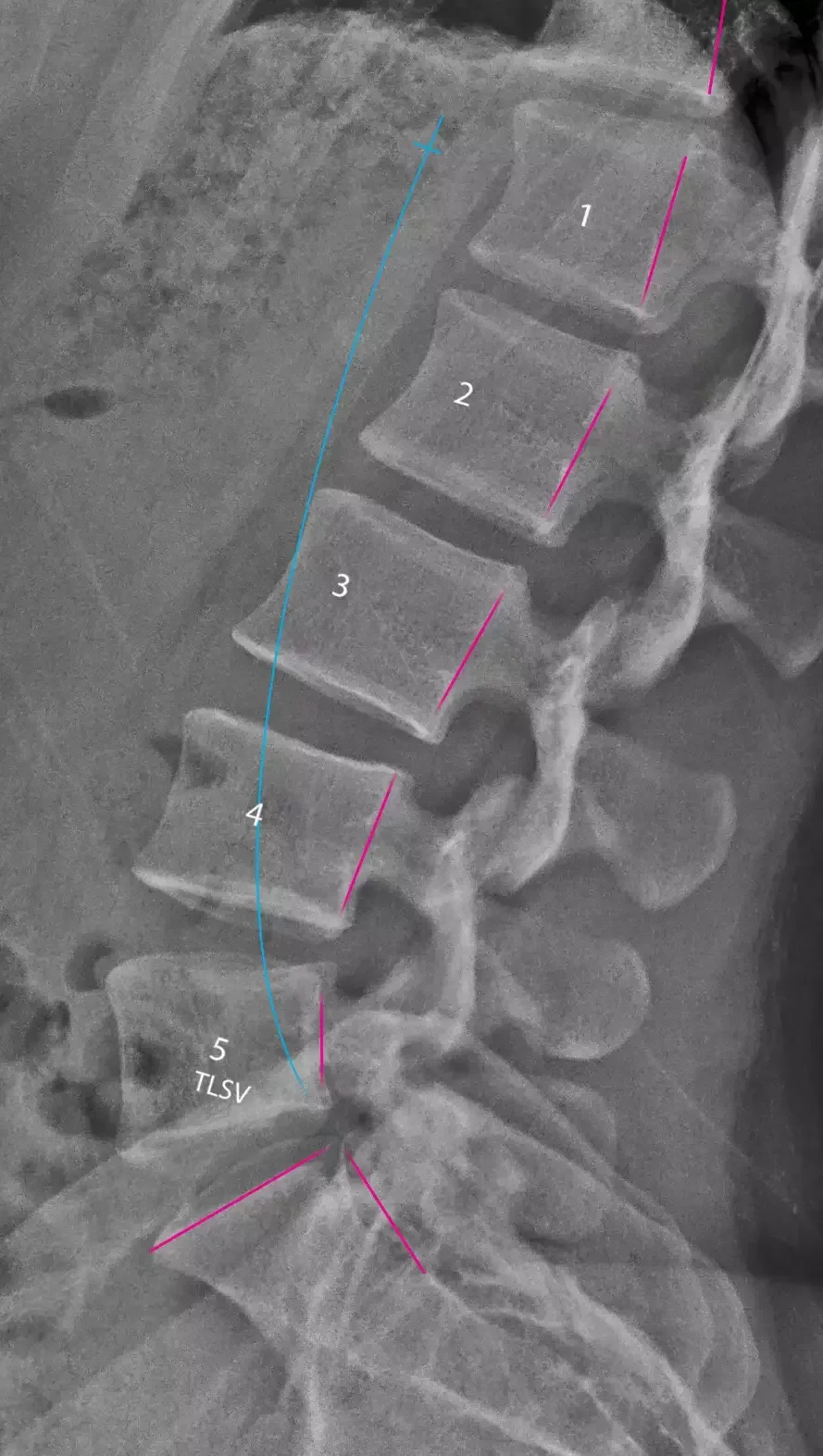
SPINAL CURVE & ALIGNMENT MEASUREMENTS
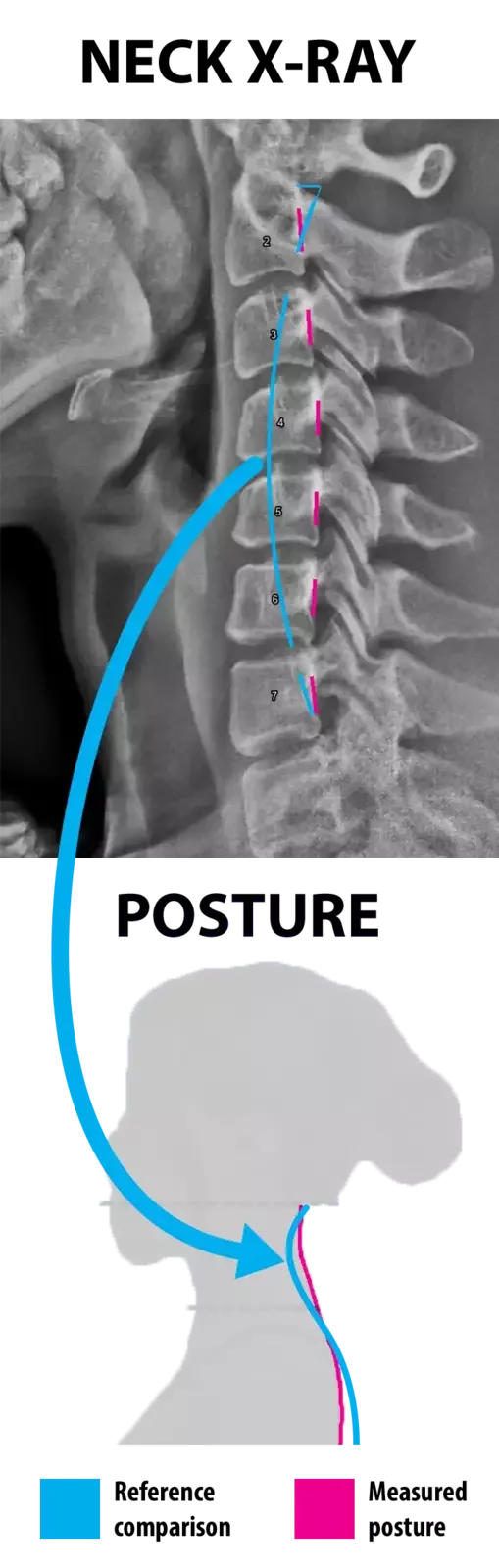
Spinal curves can be measured both globally and segment by segment.
A global measurement looks at the overall shape of a region of the spine, such as the cervical or lumbar curve.
Segmental measurements look more closely at how individual vertebrae relate to one another.
I also use translation and rotation measurements where appropriate to understand how one part of the spine is positioned relative to another.
These measurements can reveal structural relationships that are not obvious from symptoms or posture alone.
They also give us something concrete to compare later if structural change is one of the goals of care.
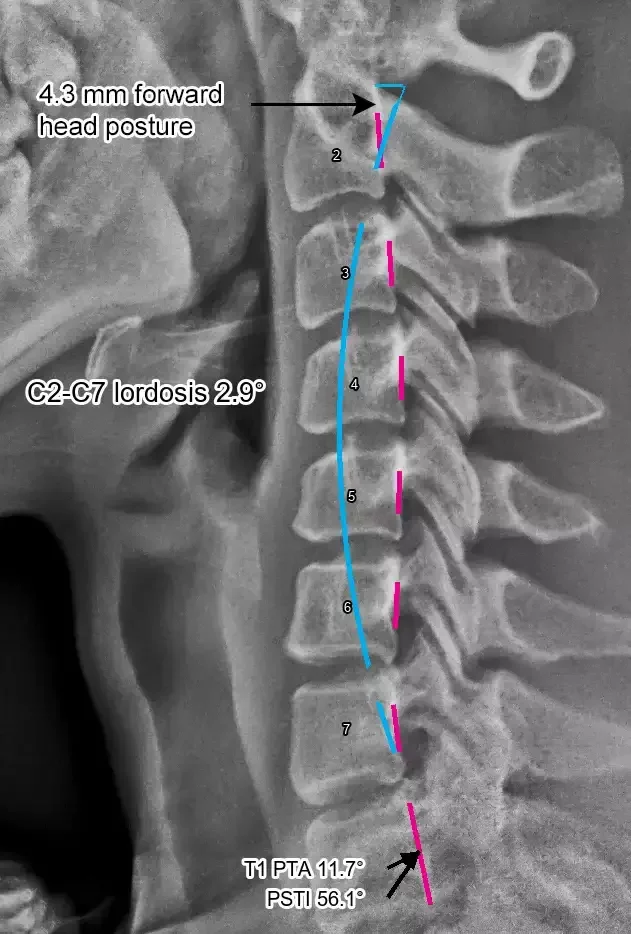
SCOLIOSIS & COBB ANGLE MEASUREMENT
When scoliosis or a lateral spinal curvature is present, I use Cobb angle measurements to quantify the size of the curve.
That gives us a standardized baseline rather than relying on visual impression alone.
When follow-up imaging is clinically justified, the same type of measurement can help determine whether a curve has changed over time.
For me, the value of the Cobb angle is not simply that it gives a number.
It helps answer:
How large is the curve?
Is it stable, improving, or progressing?
And does that information change what I recommend?
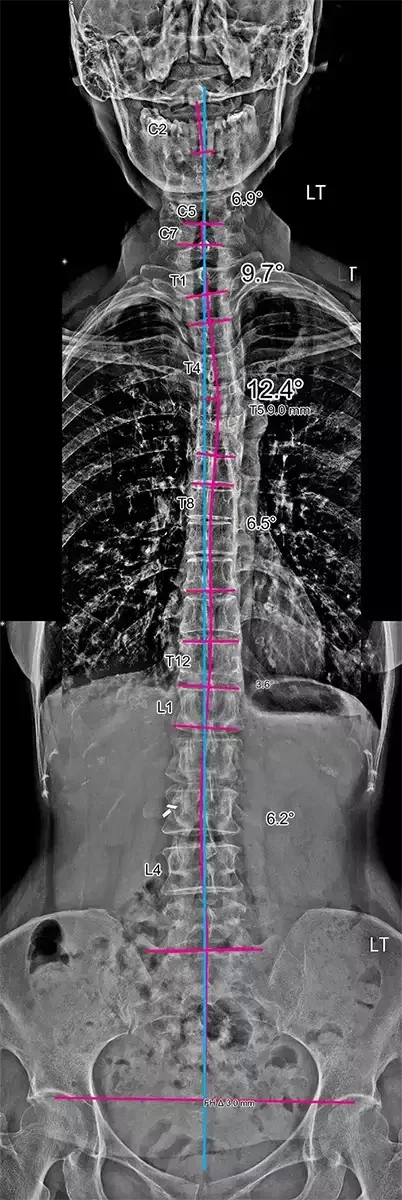
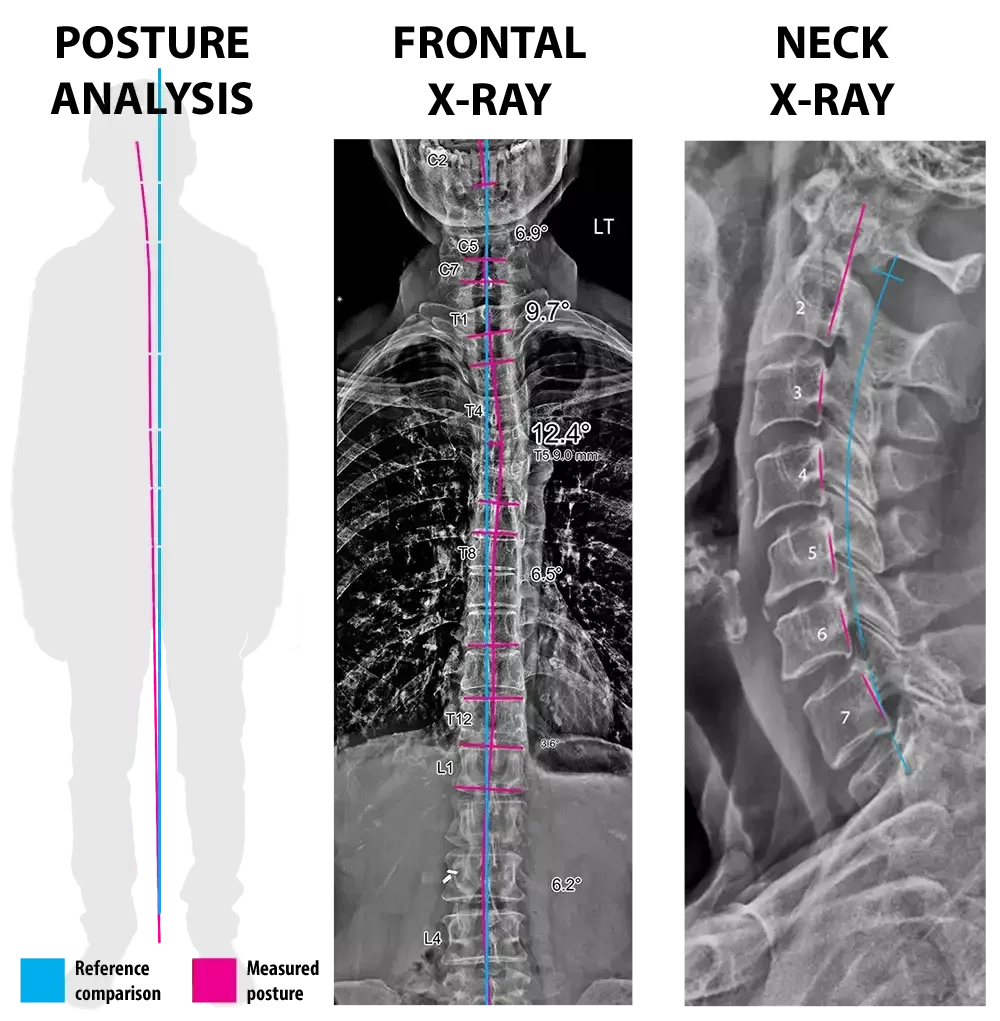
POSTURE PHOTOGRAPHY & STRUCTURAL FINDINGS
I also use standardized posture photography with every new patient.
Posture photography and X-ray measurement give me different types of information.
Posture shows how the person organizes their body externally while standing.
X-rays, when clinically indicated, show internal spinal alignment and curvature.
They are related, but they are not interchangeable.
A person can show a visible posture difference without a matching structural change on X-ray. Likewise, a measurable spinal finding may not be obvious from posture alone.
Looking at both helps me relate the internal structural finding back to the way the person actually stands and carries their body.
WHAT STRUCTURAL CORRECTION CAN INVOLVE
Structural correction is not one single technique.
I use several core strategies together, based on the structural findings and how the patient responds over time.
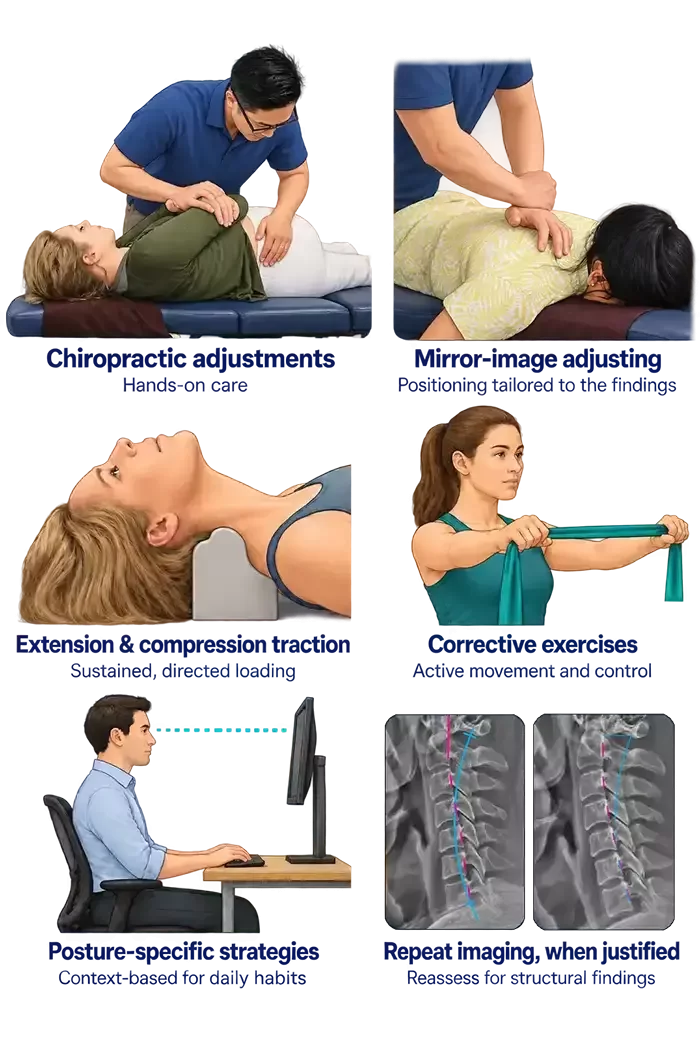
These may include:
- chiropractic adjustments
- mirror-image adjusting
- extension and compression traction
- corrective exercises
- posture-specific strategies
- repeat imaging when clinically justified
Each of these has a different role.
CHIROPRACTIC ADJUSTMENTS
Adjustments are used to improve spinal motion and address joint dysfunction as part of the broader corrective plan.
In structural care, I am not using the adjustment only to produce short-term relief.
I am also thinking about how the adjustment fits into the structural pattern I am trying to change.
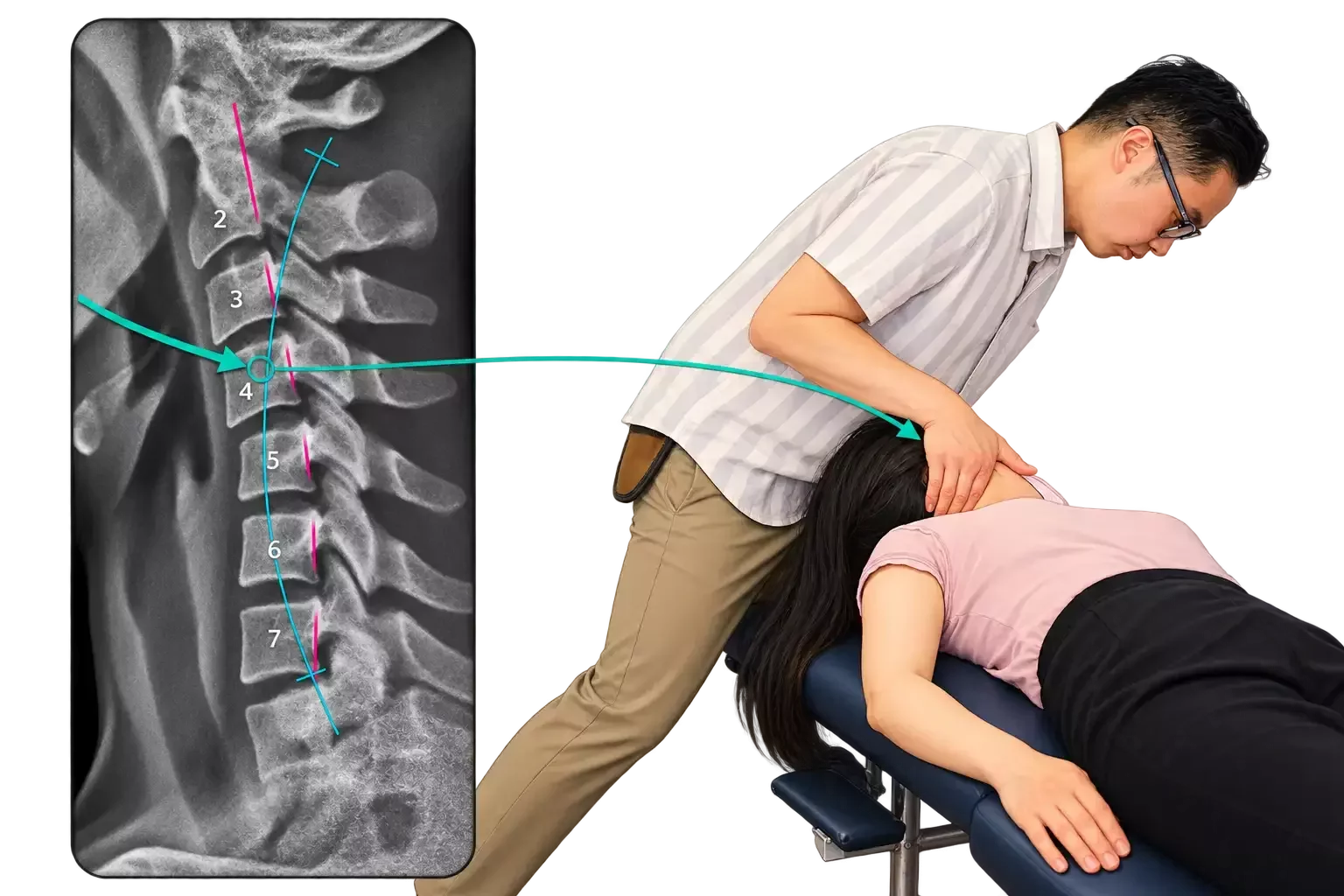
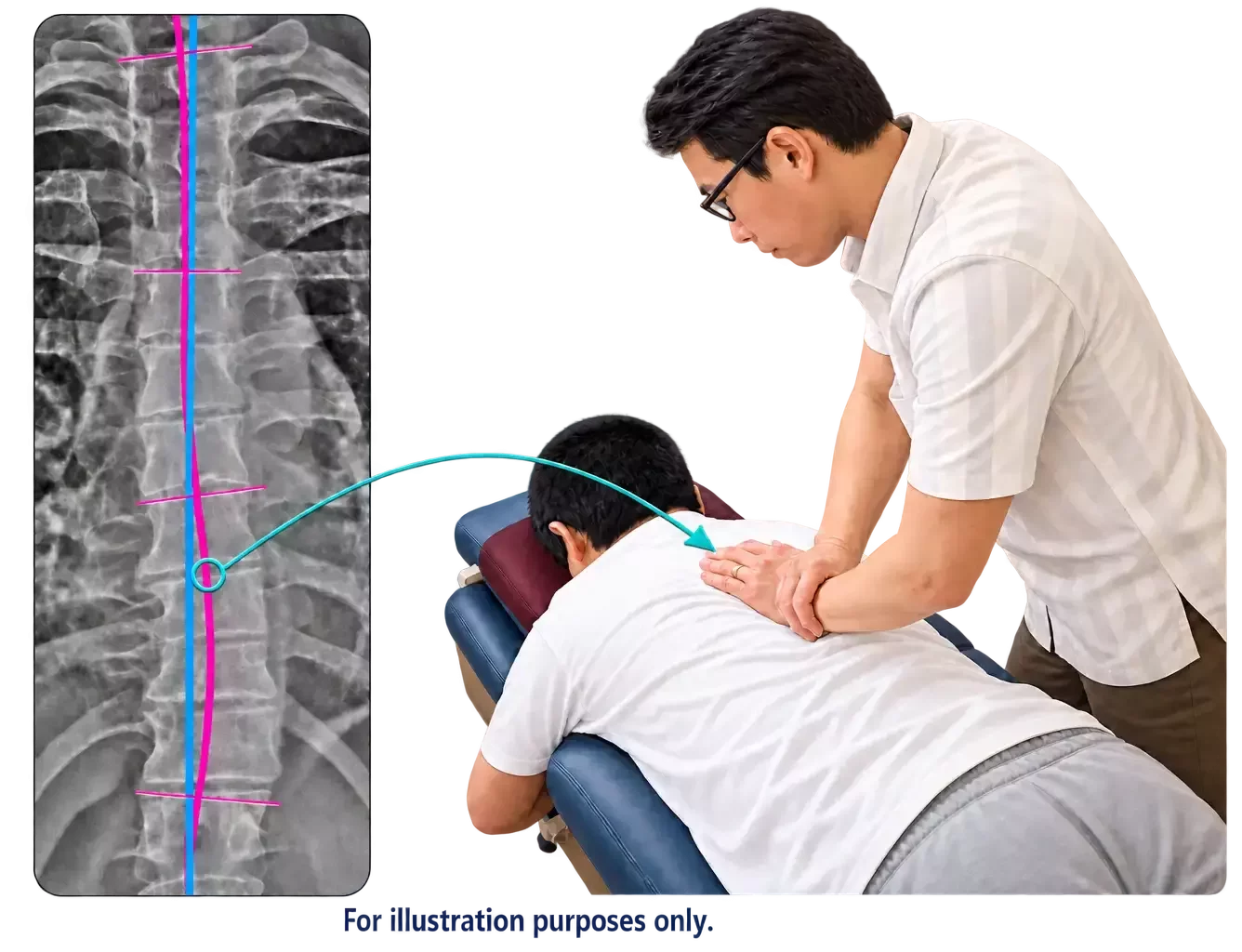
MIRROR-IMAGE ADJUSTING
Mirror-image procedures use positioning or adjusting in the direction opposite to a measured postural or structural displacement.
The goal is to introduce a corrective input that is specific to the direction of the measured finding.
I use this as part of the broader corrective strategy rather than as a standalone treatment.
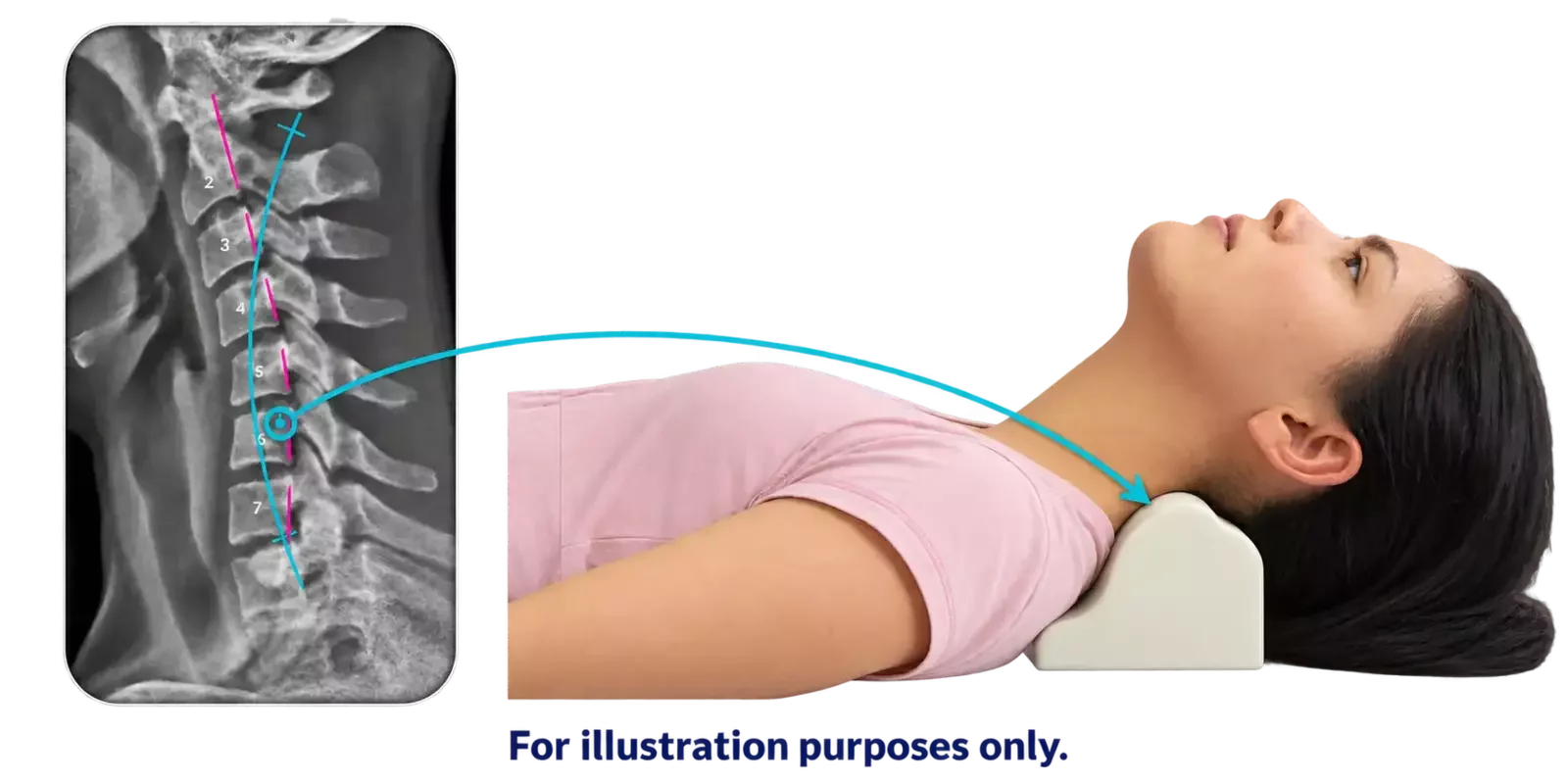
EXTENSION & COMPRESSION TRACTION
Traction is one of the main tools I use when the goal is to influence spinal curvature and alignment over time.
The setup depends on the region and the type of structural finding.
The goal is not simply to stretch the spine.
It is to apply a controlled corrective load in a direction selected from the patient’s measured alignment.
CORRECTIVE EXERCISES
Corrective exercises help reinforce the structural strategy outside of passive care.
Depending on the finding, exercises may be selected to support strength, endurance, movement control, postural awareness, or the ability to maintain a corrected position.

POSTURE-SPECIFIC STRATEGIES
Because structure and posture can influence one another, I also look at the way a patient stands, works, moves, and carries themselves during the day.
The goal is not to force everyone into the same “perfect posture.”
It is to reduce avoidable mechanical demand and support the structural changes we are trying to make.
REPEAT IMAGING WHEN CLINICALLY JUSTIFIED
If structural change is a major goal of care, there are situations where follow-up X-rays can provide useful information.
I do not repeat imaging simply because a treatment plan has ended or because a certain amount of time has passed.
When repeat imaging is justified, I use it to compare the same structural measurements against the original baseline.
STRUCTURAL CHANGE, POSTURE, CAPACITY & FUNCTION
Structural correction has a specific target – spinal alignment and curvature.
But structure does not exist in isolation.
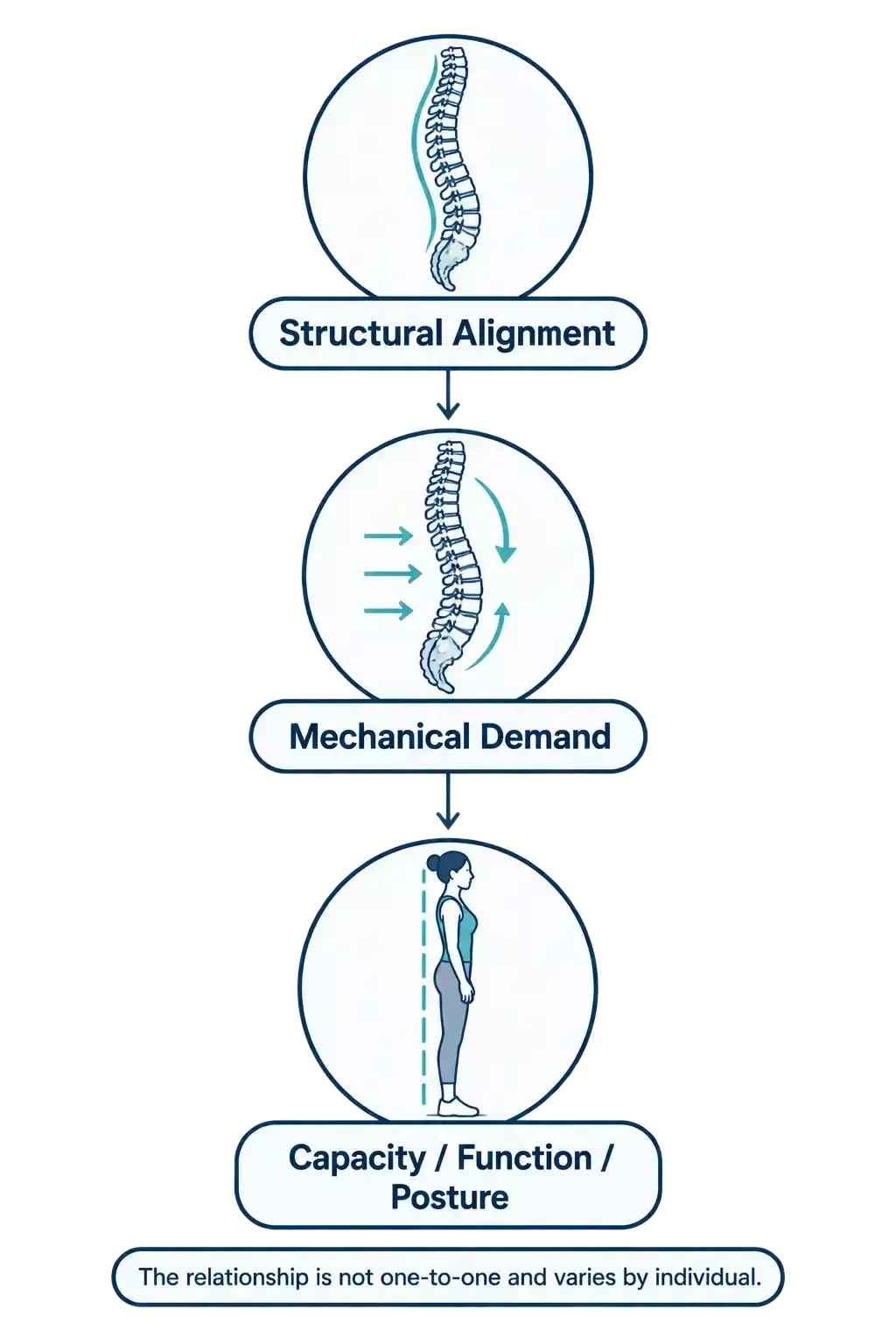
The way the spine is aligned can influence how forces are distributed through joints, muscles, and connective tissues.
If a structural finding increases the mechanical demand placed on part of the body, improving that finding may reduce some of that demand.
That can matter for posture, movement, endurance, and function.
I think of these as related parts of the same system:
Structure influences mechanical demand.
Mechanical demand affects how much capacity is required.
Capacity influences how well the body tolerates work, activity, and posture.
That does not mean every structural change produces a predictable symptom change.
It also does not mean that every patient with pain needs structural correction.
But when a meaningful structural finding is present, improving it may help create a more favourable mechanical environment for the body.
That may support:
- easier movement
- improved tolerance for sustained activity
- improved posture
- better endurance
- reduced muscular compensation
- improved function
- symptom improvement
I see these as potential outcomes rather than guarantees.
The structural goal remains measurable change in alignment.
The broader goal is to help the body function better with less unnecessary mechanical demand.
CAN STRUCTURAL CORRECTION BE RELEVANT WITHOUT PAIN?
Yes – in some cases.
Pain is important, but it is not the only thing I consider when deciding whether a structural finding matters.
A person can have a measurable spinal alignment change and feel relatively well.
That does not mean the finding will definitely cause symptoms later.
It also does not mean the finding should automatically be ignored.
Some patients come to me because they already have pain or functional limitations.
Others are more interested in:
- understanding an existing structural finding
- monitoring whether it changes over time
- addressing a curve or alignment difference before it becomes more pronounced
- improving alignment as part of a broader health or performance goal
- maintaining function as they age
- optimizing how efficiently their body handles physical demands
For those patients, I look at the whole picture.
I consider:
- the type and magnitude of the structural finding
- age
- degeneration
- whether the finding appears stable or progressive
- activity level and physical demands
- function
- previous injuries
- overall goals
- whether meaningful correction appears realistic
I do not tell patients that an asymptomatic finding will inevitably become painful.
That would be too simplistic.
But I also do not use pain as the only threshold for deciding whether a measurable structural issue deserves attention.
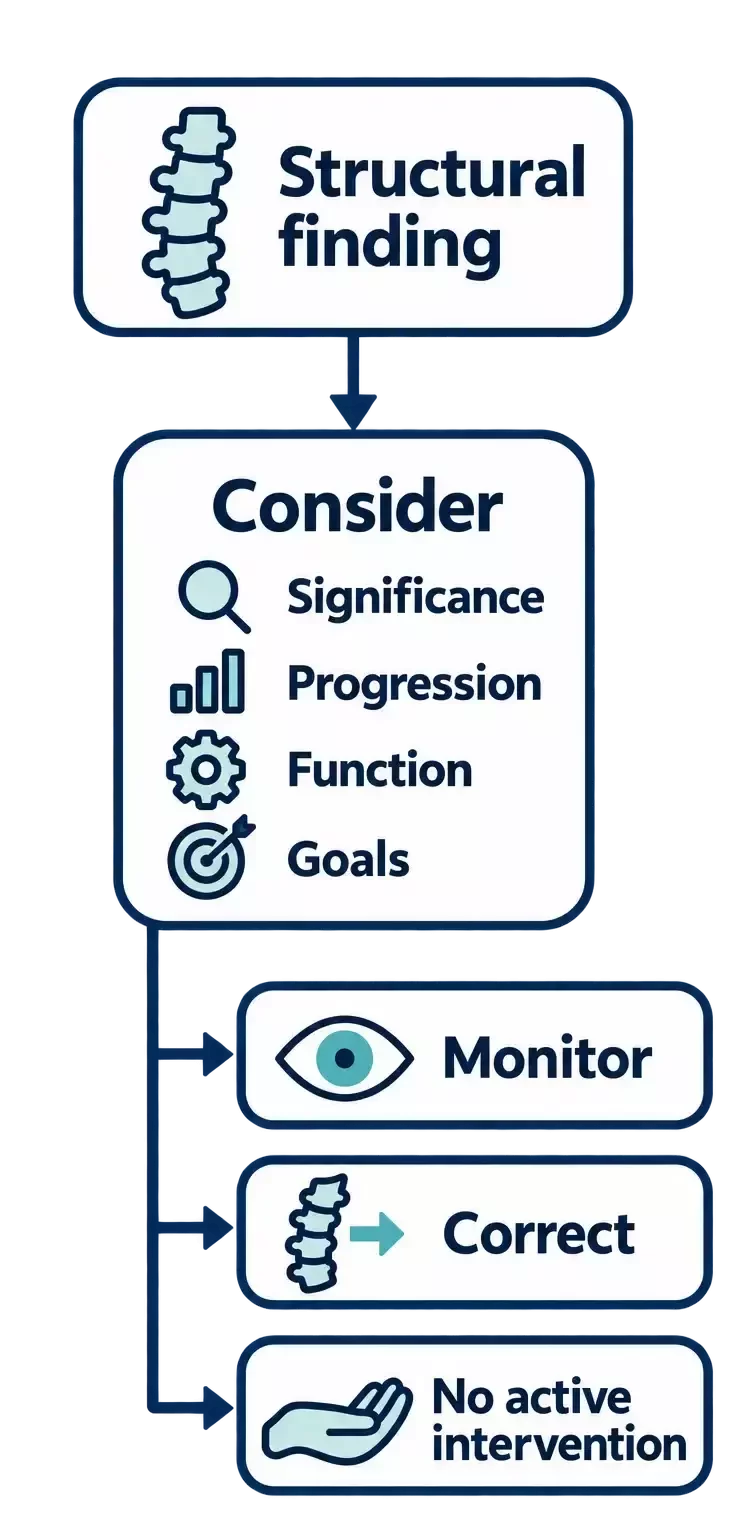
For some patients, monitoring makes the most sense.
For others, structural correction may be reasonable.
And for some, I may recommend no active intervention at all.
The goal is to make that decision deliberately rather than assume that “no pain” automatically means “nothing to address.”
HOW WE KNOW WHETHER STRUCTURAL CORRECTION IS WORKING
If structural correction is one of the goals of care, I want progress to be measurable.
I do not want to rely only on:
“I think you look better.”
or
“You seem straighter.”
Those impressions may be useful, but they are not enough.
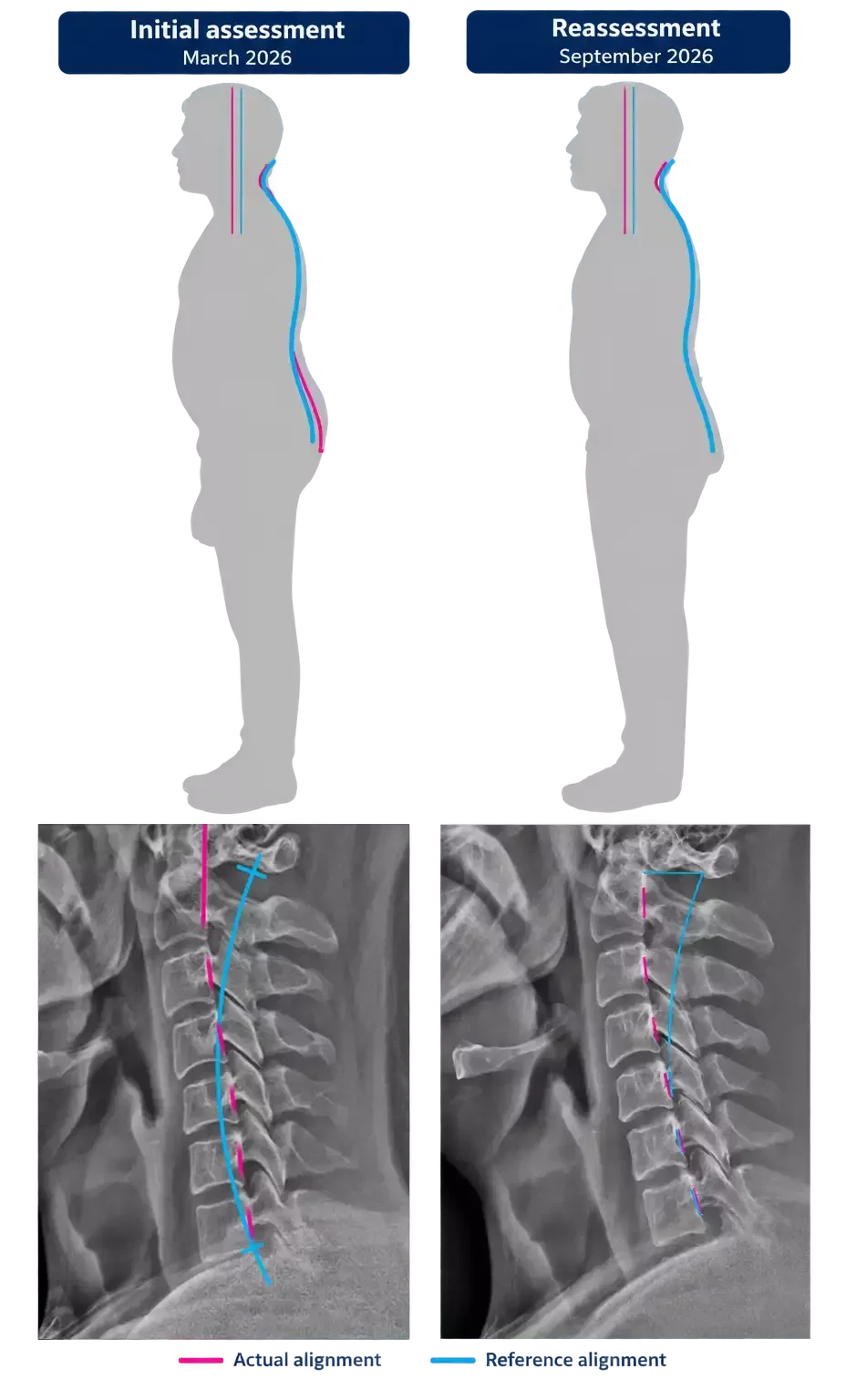
I compare progress against the original baseline.
Depending on the case, that may include:
- spinal alignment and curve measurements
- posture photography
- range of motion
- examination findings
- symptoms
- functional tolerance
- work or activity capacity
- movement quality
- patient-reported progress
- repeat imaging when clinically justified
Different outcomes answer different questions.
A patient may feel better before structural change is complete.
Another patient may show measurable structural improvement while some symptoms are slower to change.
That is why I do not use one single outcome as the only definition of success.
If the goal is structural correction, I want to know:
Did the measured structural finding change?
Did function or capacity improve?
Did symptoms change?
Did posture change?
And do those changes make sense together?
This also gives us a basis for deciding whether the plan should continue, change, or stop.
If meaningful progress is not occurring, I do not think it makes sense to simply repeat the same approach indefinitely.
CHIROPRACTIC BIOPHYSICS & STRUCTURAL CORRECTION
My approach to structural correction is influenced in part by postgraduate training in Chiropractic BioPhysics – often called CBP.
CBP places a strong emphasis on measuring spinal alignment and using those measurements to guide corrective strategies.
That framework has influenced how I use:
- posture photography
- spinal curve measurements
- translation and rotation measurements
- Harrison posterior tangent analysis
- reference spinal models
- mirror-image adjusting
- extension and compression traction
- corrective exercise
- reassessment
- repeat imaging when justified
I do not treat every patient according to a rigid protocol.
I use the measurements and corrective principles where they make sense for the individual. CBP gives me a structural and biomechanical framework.
My broader clinical approach also considers movement, symptoms, function, muscle tension, guarding, adaptability, capacity, and how the patient responds to care.
That is important to me because a person is more than an X-ray.
The structure matters.
But so does how the person moves, feels, functions, and adapts.
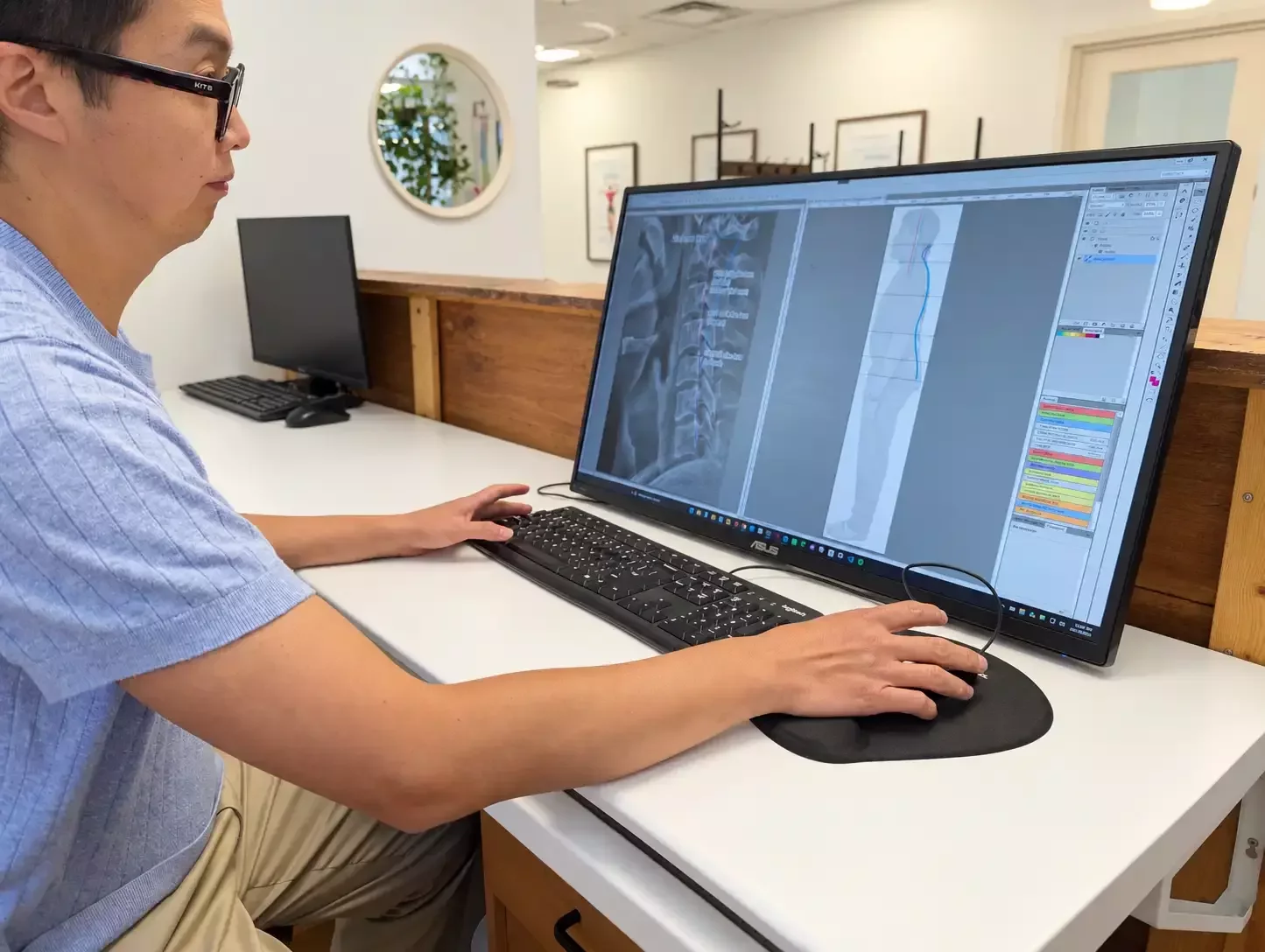
ABOUT DR. LEO QUAN
I have practised chiropractic in downtown Toronto since 2011.
Over the years, my approach has become increasingly focused on understanding not only where someone hurts, but also how their spine is functioning, how they are adapting to physical demands, and whether measurable structural findings are part of the picture.
My postgraduate training includes Chiropractic BioPhysics and NetworkSpinal.
They influence different parts of how I practise.
CBP has shaped much of my approach to spinal measurement, structural analysis, traction, corrective exercise, and measurable structural change.
NetworkSpinal has influenced how I think about tension patterns, guarding, nervous-system response, adaptability, and how much force is appropriate for a given patient.
I do not see those approaches as competing.
I use them as different lenses within an individualized assessment and care plan.
My goal is not to fit every patient into one technique or one model.
It is to understand what is actually going on, decide what appears relevant, and recommend a plan that makes sense for that person.

NEW PATIENT STRUCTURAL ASSESSMENT
If you are interested in structural correction, the first step is not treatment.
It is assessment.
Before I can tell you whether structural correction makes sense, I need to understand:
- your health history
- what brought you in
- your symptoms, if any
- your posture and movement
- your spinal and joint function
- your goals
- and whether imaging is clinically indicated
If X-rays are appropriate, I use them to measure spinal alignment and determine whether a meaningful structural finding is present.
From there, I can explain:
what I found
whether I believe it matters
whether structural correction is realistic
what are you options
and how we would measure progress
Structural correction is not something I recommend automatically.
If I do recommend it, I want you to understand why.
And if I do not think it is appropriate, I will tell you that too.
No referral required.
Call or text: 416-923-4325
Email: miracles@sourcechiro.ca
326 Adelaide Street West, Suite 301
Toronto, ON M5V 1R3